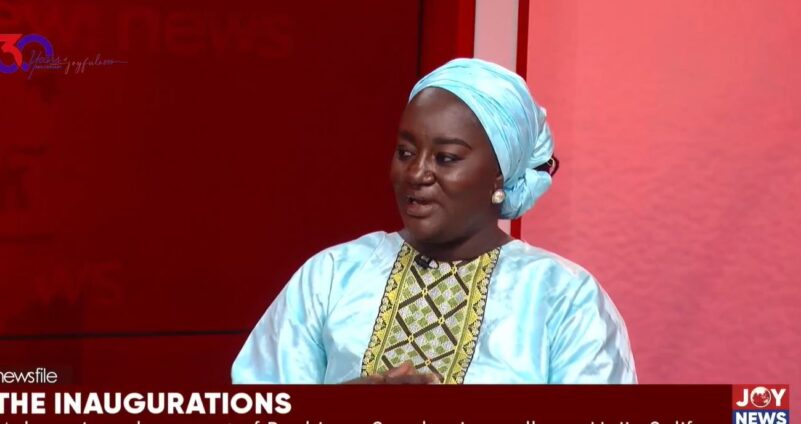
When Ghana’s ninth Parliament convened to elect its Speaker, the numbers on the floor told their own story: a chamber so finely balanced that every procedural step carried real weight. It was in that context that Hajia Rabi Salifu, Deputy National Communications Director of the New Patriotic Party, appeared on JoyNews’ Newsfile programme to raise a concern she believes goes to the heart of parliamentary democracy.
Her argument was not about the man who won the Speakership. It was about how the outcome was reached. In her view, the President’s decision to publicly name his preferred candidate before the House had voted placed a thumb on a scale that the Constitution deliberately leaves to Parliament alone.
“It was needless for the President to openly say, ‘get this person to be the leader,’ instead of allowing the electoral processes we all expected.”
The election of a Speaker, she reminded viewers, is one of the few moments when Members of Parliament act purely as an institution — before party whips, before government business, before the daily contest of majority and minority. Ghanaians watched the previous Parliament begin with a dramatic, secret-ballot election precisely because the process belonged to the House. To short-circuit that process with an open presidential endorsement, she argued, was to trade an institutional safeguard for convenience.
The Hung Parliament Lesson
Hajia Rabi pointed to the razor-thin arithmetic of the previous Parliament as evidence of why procedure matters most exactly when margins are smallest. A hung Parliament, she noted, survives on the credibility of its rules; the moment outcomes appear pre-arranged, public confidence in the institution — not just in any one party — begins to erode.
She also rejected the suggestion that the endorsement was necessary to calm post-election tensions. Ghana, she observed, had just come through a campaign and election widely praised across the continent for its peacefulness, and its institutions had earned the right to be trusted to finish the job.
“I have listened to other people from different countries, especially Nigeria, who commend Ghana for being largely peaceful from the campaign period through to post-election.”
For Hajia Rabi, the episode is a reminder that democratic culture is built in the small moments as much as the large ones. Elections end, majorities change, and parties trade places between government and opposition — but the rules must outlast them all. That, she says, is a principle worth defending from every side of the aisle, whichever party it favours on the day.
Based on her appearance on JoyNews’ Newsfile, 11 January 2025, as reported by MyJoyOnline and MyNewsGh.
← Back to all news